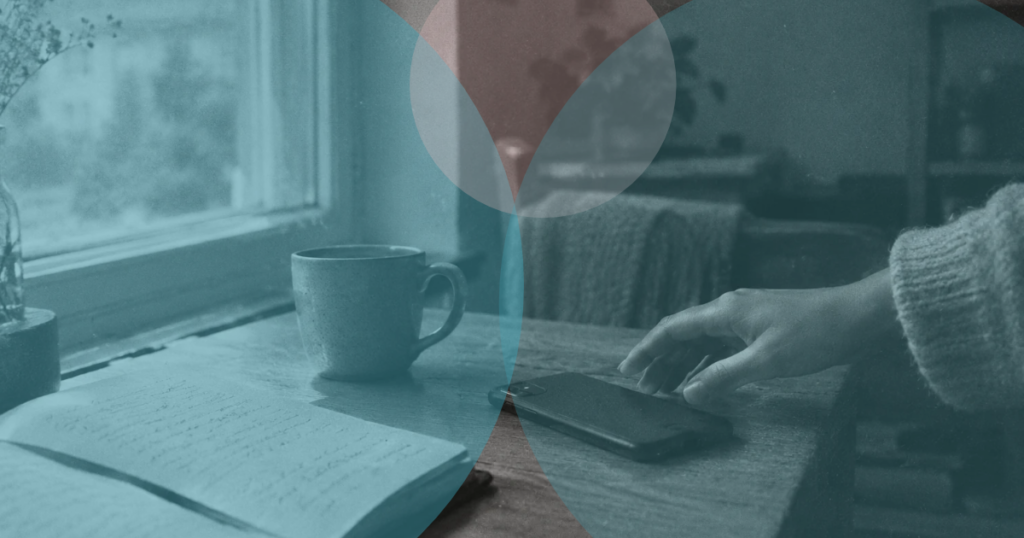
You have probably heard the phrase “brain rot” by now. It’s everywhere, from jokes to think pieces to the guilty laugh we share when we admit we lost forty minutes to short videos. We’re told to spend less time on our phones and reclaim our attention. Yet knowing a habit might not be helping us doesn’t make it any easier to change.
I know the feeling well. I pick up my phone to check one message, and a few minutes later I’m somewhere else entirely: a video, a comment thread, a stranger’s kitchen renovation. The original reason has evaporated, but my thumb is still moving.
I don’t think this is nothing. An endless stream of information, emotionally charged content, and constant interruptions can leave me feeling mentally crowded and emotionally worn out. But I’ve also learned that when I respond with shame and stricter and stricter rules, I mostly end up feeling worse (and scrolling anyway).
So lately I’ve been trying a different question. Instead of only asking “How do I stop scrolling?”, I ask: What is happening when I reach for my phone, and what am I looking for in that moment?
In this article, I’ll share what I’ve noticed, what research can and can’t tell us, and five gentle experiments that have helped me feel less on autopilot. There are no rules here, no detox, and no promise that you’ll become a different person. The aim isn’t to eliminate phone use. It’s to make a little more room for choice.
What Do We Actually Know About Phone Use and Our Well-Being?
It’s tempting to treat “phone use” as one thing, but it isn’t. Texting a friend, reading the news at midnight, and watching an hour of short videos are very different activities. Research suggests the effects may depend on what we do, how much and when, what content we encounter, and whether our use interferes with sleep, relationships, concentration, or everyday responsibilities.
“Brain rot” captures a feeling many of us recognize: foggy, scattered, a bit numb after too much scrolling. But it’s a cultural phrase, not a medical diagnosis, and it doesn’t mean anyone has measurable brain damage. I find it more useful to describe what I actually feel.
There is some encouraging research on cutting back. In a randomized controlled trial published in 2025, 111 university students were asked to reduce their smartphone screen time to no more than two hours a day for three weeks. The researchers found improvements in measures including depressive symptoms, stress, sleep quality, and well-being. However, the study was short, involved university students, and found that screen time tended to rise again after the intervention. Its findings are promising, but they don’t establish that everyone needs the same limit or that the benefits will last.
A systematic review of digital detox studies also found mixed results, suggesting that stepping away from digital media doesn’t lead to the same benefits for everyone.
So the concern is real, but the picture is more complicated than the headlines. Perhaps the most useful question isn’t simply how many hours I spend on my phone, but what those hours are made of and how I feel afterward.
What Am I Looking for When I Reach for My Phone?

When I started paying attention, I noticed that I don’t reach for my phone for one reason. Sometimes I want a short break after a demanding day. Sometimes I’m avoiding a task I don’t feel like starting. Sometimes I’m lonely and hoping for a little connection, bored and wanting stimulation, or simply too tired to make any more decisions. And sometimes I’m just following a familiar habit with no particular feeling attached.
These are possibilities, not diagnoses. Often I just want to be entertained, and there is nothing wrong with that.
But occasionally it helps to pause and ask myself a few questions:
- What am I feeling right now?
- What was I doing or thinking about just before I picked up my phone?
- What am I hoping to get from scrolling?
- How do I usually feel after spending time this way?
- Am I choosing this, or has it become automatic?
- Is there something else I need right now?
I don’t ask these questions every time, and you don’t have to either. I try not to turn curiosity into constant self-monitoring. The point is simply to become a little more familiar with my own patterns.
When the Algorithm Knows What Gets to You
This part is personal for me.
Women’s rights matter deeply to me, especially stories about violence against women. I don’t ever want to become indifferent to them. But I’ve noticed what happens when I linger on one of those stories: my feed fills with more of them. One story leads to another, and another. My energy drains away, I feel helpless, and sometimes I feel guilty for not doing more or for being unable to change what’s happening. After a while, the whole world starts to look as if it’s seen through a dark filter.
Many platforms use signals such as what we watch, like, and share to personalize our feeds. A 2025 study of Twitter, now X, found that its engagement-based ranking system amplified emotionally charged and hostile political content compared with a chronological feed. Participants also reported feeling worse about their political out-group after seeing algorithmically ranked content. The study examined one platform, so it doesn’t tell us that every algorithm works the same way. Still, it helps explain why a feed can sometimes feel so heavy.
What matters to me is the difference between caring about a problem and being continuously exposed to emotionally demanding content without choosing when to engage with it. Being informed matters, but so does having enough emotional space to live my own life, care for the people around me, and respond to the world in ways that actually help.
When Scrolling Becomes Our Way to Unwind
A while ago, I had an honest conversation with a friend I admire deeply. She is highly educated, has built a successful career, and is raising her son. From the outside, she looks like someone who has everything under control.
But she told me that everyday life is genuinely stressful for her, and that scrolling through social media in the evening is how she unwinds. I understood immediately. After a day full of responsibilities and decisions, scrolling feels easy. It asks almost nothing of us.
It also made me notice how a seemingly harmless habit can become our main way of managing stress. There’s a real difference between a form of relaxation we choose and a habit that slowly becomes hard to control.
What struck me most was how she handles it: she deliberately sets aside about half an hour in the evening for social media. She plans it in advance and enjoys it.
That gave me an idea. When the urge to scroll hits during the day, I can tell myself: There will be time for this later. Thirty minutes isn’t a magic number, and it isn’t right for everyone. The point is that deciding in advance can spare me from negotiating with myself every few minutes.
I don’t have to ban something I enjoy. I can decide when to make room for it.
Learning to Sit With Boredom
Waiting in line. Sitting on the bus. Drinking tea. Walking somewhere without anything playing in my ears. In moments like these, my hand drifts toward my pocket before I’ve even thought about it.
What happens if I let a few moments stay unfilled? Sometimes I feel restless or a little lonely. Sometimes nothing profound happens at all.
I don’t want to romanticize boredom. It can be unpleasant, and there are times when I genuinely need stimulation, company, or rest. Not every quiet moment has to become a mindfulness exercise. What I’m after is simply the possibility of not answering every flicker of discomfort with digital stimulation.
Sometimes, spending less time on our phones isn’t about finding something more productive to do. It’s about making a little room for the ordinary moments we tend to overlook: the warmth of a cup of tea, the light coming through the window, the sounds of a familiar kitchen, or a walk without anything playing in the background.
If you’d like to explore this idea further, I wrote about it in How to Romanticize Your Life Without Buying More Stuff, where I share simple ways to make everyday life feel more special without buying anything new.
Five Gentle Ways to Spend Less Time on Your Phone
Think of these as experiments, not rules. You don’t have to try all five. Choose the one that feels lightest, and leave the rest for another day.
1. Give Your Phone a Small Home
This is my favorite, and yes, it’s a little silly. Imagine your phone has a tiny personality of its own. You can even give it a name. If this little companion follows you everywhere, doesn’t it deserve a home too?
Pick a drawer, a shelf, or a quiet corner of your desk. You can make it cozy with a small plant or another simple detail, or just picture it as a peaceful place where your phone can rest after a long day. When you want to use it, you go and get it. When you’re done, you bring it back home.
I know it may sound childish, but I don’t think adults have to give up playfulness. A bit of lightness makes the habit feel less like a restriction. And having to get up to retrieve your phone can interrupt the automatic habit of checking it.
There’s also something I like about the thought that the phone gets to rest, too, while I give myself permission to rest.
2. Give Scrolling a Time of Its Own
Take a page from my friend’s book. Choose a time for social media that suits your life. It might be half an hour in the evening, or a different window entirely.
When the urge appears earlier in the day, you can tell yourself, “I’ll have time for this later.” Planning ahead makes it easier not to act on every impulse immediately.
This is a personal experiment, not a scientifically established time limit. It’s fine to adjust your plan when needed.
3. Notice the Feeling Before You Scroll
Before opening a social media app, try pausing for a breath. Ask yourself what you’re feeling and what you hope to get. Maybe you’re bored, stressed, lonely, tired, curious, or simply looking for entertainment.
You don’t have to find a deep emotional cause or stop yourself from scrolling. The aim is just to see whether you’re choosing or following a pattern. Sometimes the pause reveals that what you need is a break, a snack, or a conversation.

4. Curate Your Feed, Not Just Your Screen Time
How long I scroll matters, but so does what I’m scrolling through. A few things I’ve found helpful:
- Use “Not interested” or similar controls on posts that leave you drained.
- Mute or unfollow accounts that repeatedly overwhelm you.
- Choose a few trusted news sources instead of relying entirely on algorithmic recommendations.
- Decide when you’ll engage with distressing news, rather than meeting it all day long.
- Look for content that informs, inspires, or connects you with other people.
This isn’t about ignoring injustice, avoiding every difficult piece of information, or building a feed made only of positivity. It’s about taking a more active role in deciding what gets my attention.
5. Leave One Moment Unfilled
Choose one ordinary moment each day when you won’t automatically reach for your phone: your morning tea, a meal, waiting for the bus, or a short walk.
You don’t have to meditate or enjoy every second. Look out of the window, listen to the sounds around you, or simply feel bored. Start small; there’s no need to turn it into another demanding goal.
The goal is to rediscover that not every quiet moment needs to be filled.

A Little More Choice, a Little Less Autopilot
I’m not trying to win a battle against my phone, and I don’t think I need to become perfectly disciplined. I can take the effects of digital overload seriously and still treat myself kindly. I can admit that some habits leave me drained, notice what triggers them, and try small boundaries.
So what if the next time you reach for your phone, you don’t immediately tell yourself to stop? What if you simply pause long enough to ask what you need?
When do you find yourself reaching for your phone without really thinking about it, and what do you think you’re looking for in those moments? I’d love to hear your experience in the comments.
Sources
- Smartphone screen time reduction improves mental health: a randomized controlled trial — 2025.
- Digital detox: An effective solution in the smartphone era? A systematic literature review — 2022.
- Engagement, user satisfaction, and the amplification of divisive content on social media — PNAS Nexus, 2025.
Atgalinis pranešimas: How to Romanticize Your Life Without Buying More Stuff -
Atgalinis pranešimas: How to Rediscover Offline Hobbies and Find Joy